- Typical capillary rise height
- 1-1.5 metres above ground level
- DPCs became standard practice after
- 1875 (Public Health Act)
- Bitumen felt DPC service life
- 50-60 years (BRE Good Repair Guide 6)
- Cases in DPC-fitted buildings caused by bridging
- 60%
- Required DPC clearance above ground
- 150mm
Capillary action: the mechanism of rising damp
Rising damp is driven by capillary action, the same physical process that allows a sponge to soak up water or a paper towel to draw liquid upwards. Porous building materials like brick, stone, and mortar contain microscopic tubes (capillaries) that pull water upward against gravity.
The narrower the capillary, the higher the water can rise. In typical UK masonry (brick with lime or cement mortar), capillary rise reaches 1-1.5 metres above ground level.1 At this height, the rate of water evaporation from the wall surface equals the rate of capillary rise from below, creating an equilibrium.
The height varies depending on:
- Material porosity: Soft, porous bricks and lime mortar have larger capillaries, allowing water to rise higher. Dense engineering bricks and cement mortar have smaller capillaries, limiting rise.
- Ground moisture levels: Clay subsoils and high water tables supply more water. Sandy, free-draining soils provide less.
- Ventilation: Good airflow increases evaporation, lowering the tide mark. Poorly ventilated rooms (or walls covered with impermeable finishes) trap moisture, pushing the tide mark higher.
Building Research Establishment (BRE) Digest 245 (2007) notes that capillary rise is not a defect in itself but a natural property of porous materials. Rising damp becomes a problem when buildings lack a barrier to interrupt the capillary pathway.
Missing damp proof course (pre-1875 buildings)
Damp proof courses (DPCs) became common practice after the Public Health Act 1875, which introduced minimum building standards for new construction.5 Before this date, most buildings were constructed without any form of damp barrier.
Pre-1875 properties (Georgian, Regency, early Victorian) typically relied on:
- Breathable lime mortar and plaster that allows moisture to evaporate naturally.
- Good external drainage and adequate clearance between ground level and wall base.
- Thick solid walls (typically 450mm+) that absorb moisture slowly and release it before it reaches the interior surface.
These strategies worked well in many cases, which is why numerous pre-1875 buildings have survived 150+ years without a DPC and show no damp issues. However, if ground levels have been raised, external drainage has deteriorated, or impermeable cement render has been applied (trapping moisture inside the wall), rising damp can develop.
Historic England's guidance (Remedying Damp in Historic Buildings, 2016) emphasises that rising damp in old buildings is often a symptom of later modifications (raised ground, cement repairs) rather than an inherent design flaw.
Degraded or damaged damp proof course
Buildings constructed between 1875 and the mid-20th century often used slate, engineering brick, or bitumen felt DPCs. These materials can fail over time:
Bitumen felt DPCs (1920s-1970s)
Bitumen felt (hessian fabric impregnated with bitumen) was the standard DPC material from the 1920s to the 1970s. It is effective when new but becomes brittle after 50-70 years. Cracks and tears allow water to bypass the barrier.
Bitumen degradation is accelerated by:
- Exposure to sulfates in the ground, which attack bitumen chemically.
- Thermal cycling (freeze-thaw), which causes the felt to crack.
- Poor installation (incomplete lapping at joints), leaving gaps from the start.
BRE Good Repair Guide 6 (2005) estimates that bitumen felt DPCs have a typical service life of 50-60 years.2 Any building from the 1960s or earlier with an original DPC is a candidate for failure.
Slate DPCs (Victorian and Edwardian)
Slate DPCs consist of two overlapping courses of Welsh slate embedded in the mortar bed. They are very durable but can crack if the building settles or if the supporting mortar bed deteriorates.
Slate DPCs are also vulnerable to bridging if internal plaster or external render is applied across the slate course, creating a moisture path above or below the barrier.
Structural movement
Subsidence, settlement, or wall bulging can tear a DPC, especially plastic sheet types. This is common in properties with shallow foundations on clay soils, where seasonal ground movement is significant.
If you see stepped cracks in external brickwork at DPC level, suspect a torn or displaced DPC. A structural engineer's assessment is needed before any damp proofing work.
Bridging: bypassing a functional DPC
Bridging is one of the most common causes of rising damp in buildings that already have a DPC. It occurs when a material or feature provides a continuous moisture path that bypasses the DPC, allowing water to enter the wall above the barrier.
Raised ground levels
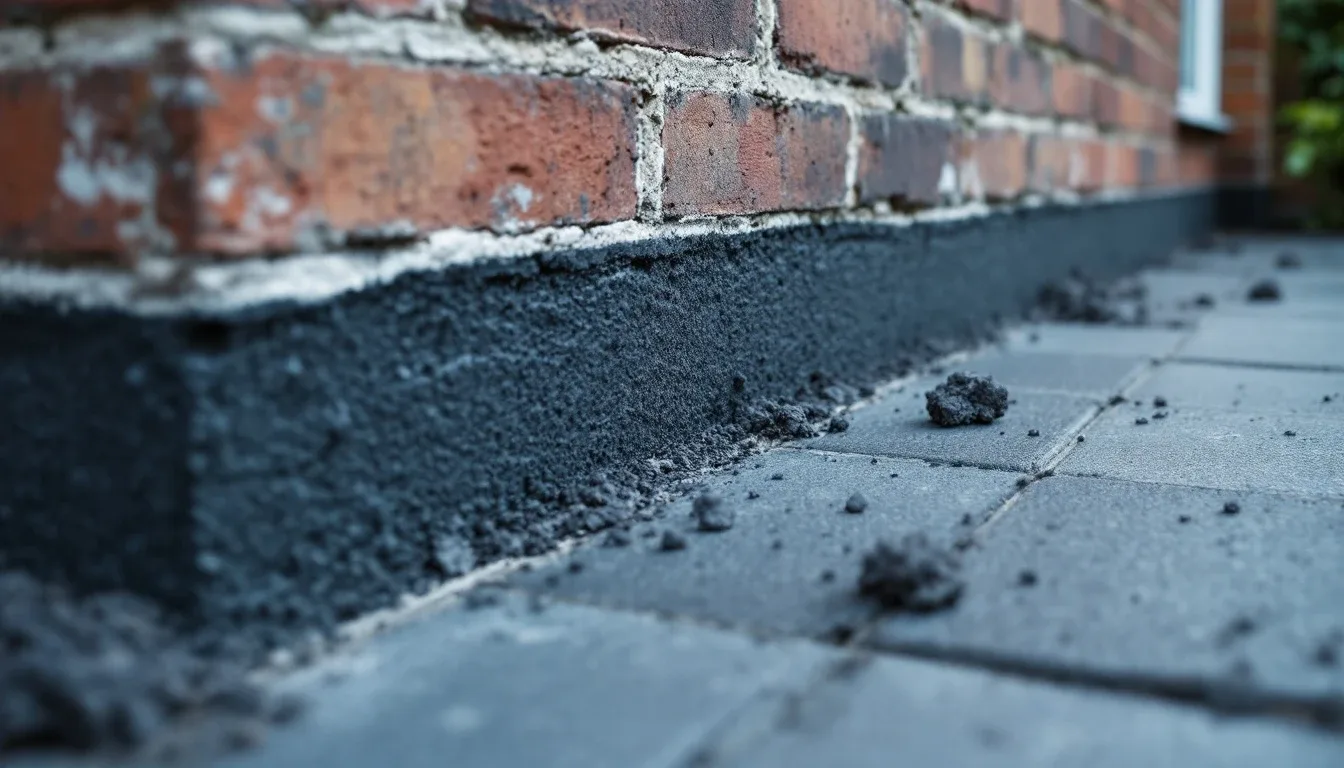
Building Regulations require DPCs to sit at least 150mm above external ground level.4 If soil, paving, or flower beds are piled against the wall above the DPC, water can enter the masonry above the barrier and rise from there.
This is extremely common in terraced houses where gardens have been levelled or patios installed without maintaining the required clearance. The solution is simple: lower the ground level to expose the DPC. No chemical injection is needed.
External render below DPC level
Cement render applied to the external wall face below the DPC creates a capillary bridge. Water is drawn up through the render, bypasses the DPC, and enters the wall above the barrier.
This is particularly common in houses that have been rendered for thermal insulation or to cover poor brickwork. If rising damp appears after rendering work, bridging is the likely cause.
The fix is to cut back the render to expose the DPC and create a visible break in the render line. Alternatively, apply a proprietary anti-bridging membrane over the render at DPC level.
Internal plaster continuity
Less commonly, internal plaster applied continuously from below to above the DPC can act as a bridge, especially if the plaster is dense cement-based render rather than breathable lime.
BRE Good Repair Guide 6 states that 60% of rising damp cases in buildings with an existing DPC are caused by bridging rather than DPC failure. Always check for bridging before specifying DPC replacement or chemical injection.
High ground moisture levels
The severity of rising damp depends on how much water is available in the ground. High ground moisture is caused by:
Clay subsoils
Clay soils retain water and drain slowly. Buildings on heavy clay (common in London, the Thames Valley, and parts of the Midlands) experience persistent ground moisture, especially in winter when rainfall exceeds evaporation.
Sandy or gravelly soils drain quickly, so ground moisture levels are lower even after heavy rain. Rising damp is less common in free-draining areas.
High water tables
Properties built on low-lying ground, near rivers, or in flood zones may have water tables that rise close to the surface in winter. This increases the supply of water available for capillary rise.
Poor external drainage
Blocked gullies, broken drains, or missing downpipes allow rainwater to pool against the base of external walls. Over time, this saturates the ground and increases capillary rise.
Check that:
- Gutters and downpipes are clear and discharge at least 1 metre from the wall base.
- Ground slopes away from the building to shed surface water.
- Drains are functioning and not leaking into the subsoil.
Improving drainage can reduce rising damp severity or eliminate it entirely, even in buildings without a DPC.
Wall porosity and material choice
Not all masonry is equally susceptible to rising damp. The porosity of bricks and mortar determines how easily water can rise:
Porous bricks (high risk)
Soft, handmade bricks (common in pre-1900 buildings) and some modern facing bricks have high porosity (over 20% water absorption by weight). These materials act as effective capillary pathways.
Dense engineering bricks (low risk)
Engineering bricks (Class A or B) have water absorption below 4.5-7% and are almost immune to capillary rise. Two courses of engineering brick were often used as a DPC in Victorian buildings.
Lime mortar vs cement mortar
Lime mortar is softer and more porous than cement mortar, so it allows higher capillary rise. However, lime mortar also allows faster evaporation, which is why lime-built buildings can tolerate moisture movement without damage.
Cement mortar is denser and restricts capillary rise, but it also traps moisture inside the wall. Repointing a lime-built wall with hard cement mortar can worsen damp problems by preventing natural evaporation.
Why rising damp persists after DPC installation
Even after a new DPC is installed (chemical injection or physical retrofit), walls can remain damp due to hygroscopic salts. These salts (nitrates, chlorides, sulfates) are carried up from the ground by capillary water. When the water evaporates, the salts are left behind in the plaster.
Hygroscopic salts absorb moisture from the air, keeping the wall damp even though no water is rising from below. This is why replastering with salt-retardant renovating plaster is essential after DPC installation. Without replastering, the wall will continue to show damp staining and decoration failure.
Do all buildings need a damp proof course?
Not necessarily. Many pre-1875 buildings have survived without a DPC because they were built with breathable materials, good drainage, and adequate ground clearance. Rising damp only becomes a problem if these conditions are compromised.
Modern buildings use a DPC as standard because:
- Ground clearance is often minimal due to space constraints.
- Modern materials (cement mortar, gypsum plaster) are less breathable than traditional lime.
- Building Regulations require a DPC for new construction (Approved Document C).
If you own a pre-1875 building without a DPC and have no damp problems, do not retrofit a DPC preemptively. Focus on maintaining breathability, drainage, and ground clearance instead.
Sources
- BRE Digest 245 (2007): Rising damp in walls - diagnosis and treatment
- BRE Good Repair Guide 6 (2005): Treating rising damp in houses
- Historic England (2016): Remedying Damp in Historic Buildings
- Building Regulations Approved Document C (2022): Resistance to moisture
- Public Health Act 1875: Minimum building standards