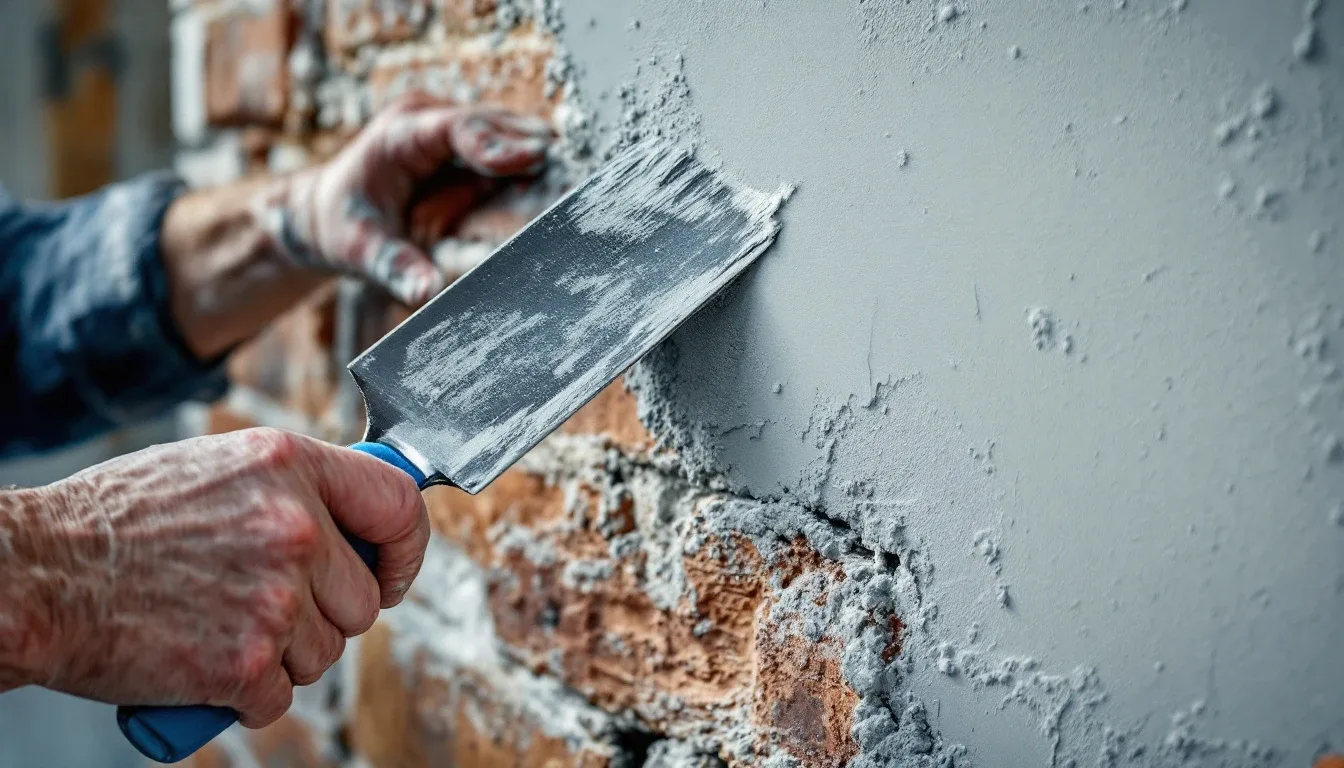
- Two-coat system thickness
- 20-25mm total
- Air voids in the plaster
- 40-50% of plaster volume
- Installed cost
- £80-120 per m²
- Materials only
- £15-25 per m²
- Wait before decorating
- 4 weeks minimum
What is damp proof plaster?
Damp proof plaster, also known as renovating plaster or salt-retardant plaster, is a specialist plaster system designed for walls affected by rising damp, penetrating damp, or hygroscopic salt contamination.
Unlike standard gypsum plaster, which is dense and relatively impermeable, renovating plaster is lightweight and highly porous. This porosity allows:
- Residual moisture to evaporate through the plaster rather than being trapped behind it.
- Hygroscopic salts (nitrates, chlorides, sulfates) to migrate to the plaster surface where they evaporate harmlessly, rather than crystallising behind the finish and causing the plaster to blow (lift away from the wall).
Renovating plaster is typically used after a new damp proof course (DPC) has been installed. Even after a DPC stops capillary rise, hygroscopic salts remain in the masonry. These salts continue to draw moisture from the air, so the wall appears damp and decorations fail unless the plaster is replaced with a salt-retardant system.
How does renovating plaster work?
Rising damp carries dissolved salts from the ground. As water evaporates from the wall surface, these salts are left behind in the plaster. Over time, the salts become hygroscopic, meaning they absorb moisture from the air even when no water is rising through the masonry.
Standard gypsum plaster is dense and traps salts behind the finish. As salts crystallise, they expand and push the plaster away from the wall. This causes bubbling, flaking, and eventual failure of the plaster and any decorations applied over it.
Renovating plaster works differently. It is formulated with:
- High porosity: Air voids make up 40-50% of the plaster volume3, allowing moisture to evaporate freely.
- Hydrophobic additives: Water-repellent polymers prevent liquid water from penetrating the plaster while allowing water vapour to pass through.
- Low capillarity: Large pore sizes prevent capillary suction, so salts migrate to the surface rather than being drawn into the plaster body.
Salts move to the plaster surface and evaporate as a fine white powder. This can be brushed off periodically during the first 6-12 months after application2. Once the wall has fully dried and the salt reservoir is exhausted, the efflorescence stops.
When to use damp proof plaster
After rising damp treatment
Renovating plaster is essential after installing a new DPC (chemical injection or physical insertion). BRE Good Repair Guide 6 (2005) states that chemical DPC injection and replastering with renovating plaster are a package treatment. One without the other is unlikely to achieve a dry wall.
Even if the DPC stops capillary rise completely, hygroscopic salts in the old plaster continue to absorb moisture from the air. The wall remains damp, and decorations fail. Only by removing the contaminated plaster and replacing it with a salt-retardant system can the wall be made dry and decorable.
After long-term penetrating damp
If penetrating damp (from leaking gutters, failed pointing, or cracked render) has been present for months or years, hygroscopic salts may have accumulated in the plaster. Even after fixing the external cause, the wall continues to show damp staining due to these salts.
Use renovating plaster if:
- White salt crystals are visible on the surface.
- The wall feels damp to touch weeks after fixing the external leak.
- Previous redecoration failed within 6-12 months.
In basements and cellars
Below-ground rooms are prone to residual moisture and salt contamination, even with cavity drain membrane waterproofing systems. Renovating plaster is the standard finish over membrane systems because it allows any moisture that penetrates the membrane to evaporate through the plaster rather than being trapped.
When NOT to use damp proof plaster
Renovating plaster is not needed for:
- Condensation: Surface moisture from indoor humidity requires ventilation and heating improvements, not specialist plaster. Standard gypsum is fine after fixing the condensation cause.
- Short-term penetrating damp with no salt contamination: If a leak is recent (weeks rather than months) and no salts are visible, standard gypsum plaster can be used after fixing the external cause and allowing the wall to dry.
- New construction: Walls built with a DPC and no history of damp do not require renovating plaster.
Types of damp proof plaster systems
Two-coat renovating plaster systems (most common)
Most renovating plasters are applied in two coats:
Base coat (scratch coat or rendering coat): 15-20mm thick. Contains lightweight aggregates (expanded perlite, vermiculite, or polystyrene beads) and hydrophobic additives. Provides the main salt-retardant and moisture-evaporation function.
Finishing coat: 5-10mm thick. Similar composition to the base coat but with finer aggregates for a smoother surface. Can be left as a textured finish or skimmed with a thin layer of standard gypsum plaster for a smooth, decorable surface.
Common brands:
- Limelite Renovating Plaster: Two-coat system. Base coat + finish coat. Total thickness 20-25mm. £12-18 per m² materials.
- Dryzone Damp-Resisting Plaster: Single base coat + gypsum skim. £15-20 per m² materials.
- Sika MonoTop: Cementitious renovating plaster. Used in basements and high-moisture environments. £18-25 per m² materials.
- Koster NB1 / NB4000: German system. High performance but expensive. £25-35 per m² materials.
Single-coat systems with gypsum skim
Some renovating plasters use a single thick base coat (15-20mm) followed by a standard gypsum skim (2-3mm). This is faster and cheaper but relies on the gypsum skim being vapour-permeable, which limits its effectiveness in very damp conditions.
Lime-based renovating plasters
Traditional lime plaster is naturally breathable and salt-tolerant. In heritage buildings, lime plaster with added pozzolanic materials (crushed brick, volcanic ash) can function as a renovating plaster without modern synthetic additives.
Lime systems take longer to cure (weeks rather than days) and require skilled application, but they are preferred in listed buildings and conservation areas where modern materials may not be approved.
Application process
1. Remove contaminated plaster
Hack off all existing plaster to at least 300mm above the highest visible tide mark or damp patch. Remove plaster down to bare masonry. Do not leave any contaminated plaster, as salts will migrate into the new finish.
For rising damp, remove plaster to 1 metre above floor level as a minimum. For severe salt contamination, remove to full ceiling height.
2. Clean the wall
Brush off loose mortar, dust, and salt deposits. Some plasterers recommend washing the wall with clean water to remove surface salts, but this is controversial because it wets the wall further. If washing is done, allow 2-4 weeks drying time before plastering.
3. Apply a salt-inhibiting primer (optional)
Some systems recommend a primer coat (usually a diluted slurry of the base coat material) to improve adhesion and reduce salt migration. Follow the manufacturer's instructions.
4. Apply base coat
Mix the base coat plaster according to the manufacturer's instructions. Apply to 15-20mm thickness using a steel trowel. Key (scratch) the surface while still wet to provide grip for the finishing coat.
Allow 24-48 hours drying time before the next coat, depending on ambient temperature and humidity.
5. Apply finishing coat
Apply the finishing coat to 5-10mm thickness. Trowel smooth or leave textured depending on the final decoration planned.
If a gypsum skim is to be applied, allow the finishing coat to cure for 7-14 days, then apply a thin (2-3mm) gypsum plaster skim for a smooth, decorable surface.
6. Decoration
Allow at least 4 weeks before decorating to ensure the plaster is fully cured and initial salt efflorescence has subsided. Use breathable paint (emulsion or lime wash) rather than vinyl or oil-based paints, which trap moisture behind the finish.
How much does damp proof plaster cost?
Materials
- Base coat: £8-15 per m² (15-20mm thickness).
- Finishing coat: £5-10 per m² (5-10mm thickness).
- Gypsum skim (if used): £2-3 per m².
- Total materials: £15-25 per m².
Labour
- Hacking off old plaster: £15-25 per m².
- Applying renovating plaster (base + finish): £40-60 per m².
- Skimming (if required): £8-12 per m².
- Total labour: £60-90 per m².
Total installed cost
£80-120 per m² for hacking off, applying two-coat renovating plaster, and skimming. A typical room with 20m² of affected wall area costs £1,600-2,4001.
This is 30-50% more expensive than standard gypsum plastering (£50-80 per m²) due to specialist materials and longer application time.
Can you DIY damp proof plaster?
Yes, if you have plastering experience. Renovating plaster is applied using the same techniques as standard plaster, but the material is lighter and can be more difficult to trowel smooth.
Key points for DIY:
- Follow the manufacturer's mixing instructions precisely. Too much water weakens the plaster and reduces its salt-retardant properties.
- Work in small sections. Renovating plaster sets faster than gypsum, giving less working time.
- Key (scratch) the base coat while wet to provide grip for the finishing coat.
- Allow adequate drying time between coats. Applying the finish coat too soon can trap moisture and cause failure.
- Use breathable paint for decoration. Vinyl or oil-based paints will trap moisture and cause the finish to fail.
If you have no plastering experience, hire a professional. Poor application can trap salts behind the finish, negating the benefits of the specialist plaster.
Does damp proof plaster replace a DPC?
No. Renovating plaster manages the symptoms of damp (residual moisture and salts) but does not stop capillary rise. A damp proof course (DPC) must be installed first to stop water rising through the masonry.
The correct sequence for rising damp treatment is:
- Install a new DPC (chemical injection or physical insertion).
- Allow 4-6 weeks for the DPC to cure.
- Hack off contaminated plaster to 300mm above the highest tide mark.
- Apply renovating plaster.
- Allow 4+ weeks before decorating.
Skipping the DPC installation and applying renovating plaster alone will not solve rising damp. The plaster will become saturated and fail within 12-24 months.
How long does damp proof plaster last?
When applied correctly after DPC installation, renovating plaster should last the life of the building (60+ years)4. The plaster itself is durable and does not degrade.
However, if the underlying moisture source is not fixed (failed DPC, leaking gutter, poor drainage), the plaster will eventually become saturated and fail. Renovating plaster can tolerate more moisture than standard gypsum, but it is not a permanent solution for ongoing water ingress.
Sources
- BRE Good Repair Guide 6 (2005): Treating rising damp in houses (accessed 3 July 2026)
- BRE Digest 245 (2007): Rising damp in walls - diagnosis and treatment (accessed 3 July 2026)
- BS 5492:1990+A2:2013: Code of practice for internal plastering (accessed 3 July 2026)
- Historic England: Mortars, Renders and Plasters (Technical Advice Note, 2012) (accessed 3 July 2026)