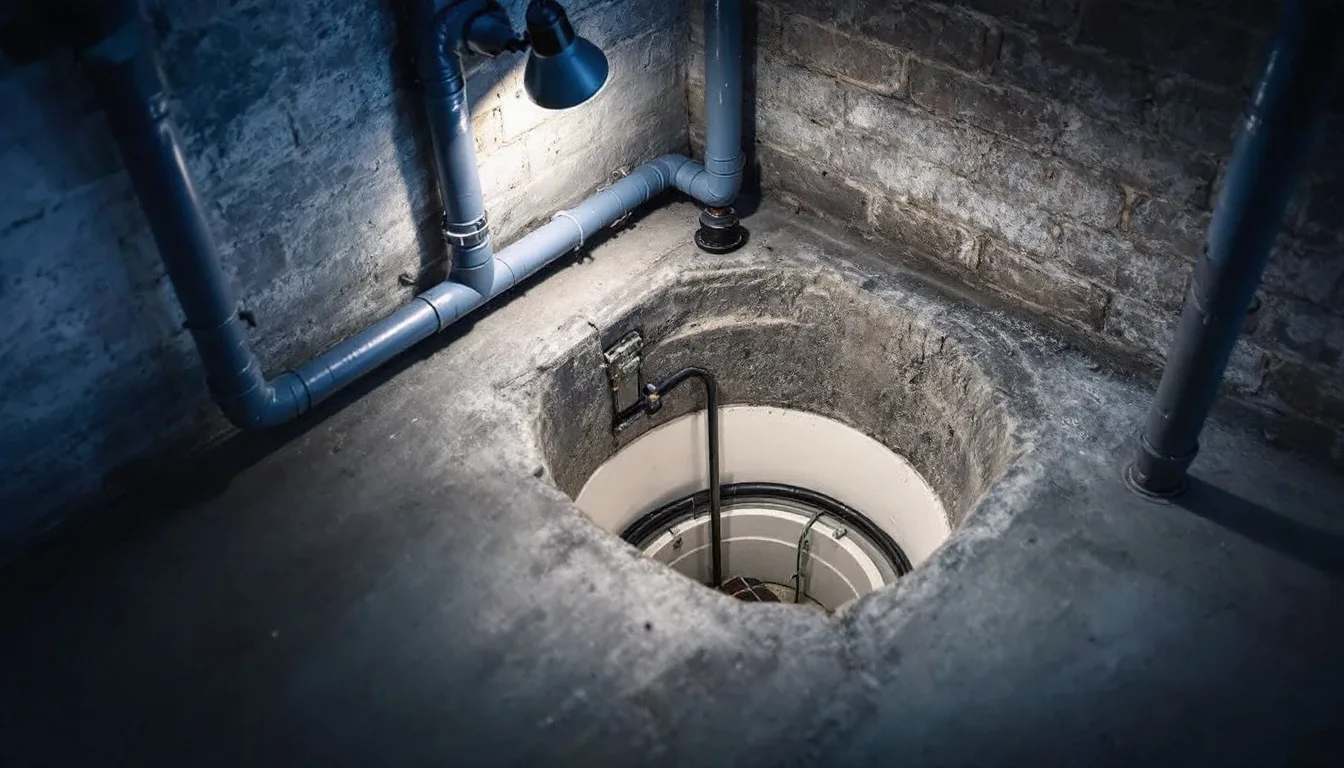
- Waterproofing standard
- 2009 (BS 8102:2009 code of practice)
- Type C cavity drain
- £80-150 per m²
- Type B cementitious
- £60-100 per m²
- Type A external tanking
- £100-200 per m²
- Example cellar conversion (Type C)
- £6,600-10,800 total for a 4m x 5m cellar
Why cellars need waterproofing
Cellars are below ground level, so they face hydrostatic pressure from groundwater in the surrounding soil. Water is forced through porous masonry materials (brick, stone, mortar) and through cracks or joints, causing damp walls, wet floors, and musty air.
Traditional cellars (pre-1900) were built for storage, not habitation, so they were often constructed with minimal damp protection.3 Many have no damp proof course (DPC), thin or absent floor slabs, and lime mortar that is porous to water.
Modern cellar conversions must meet Building Regulations for habitable rooms, which require dry, healthy internal environments. This means installing a waterproofing system that complies with BS 8102:2009 (Code of practice for protection of below ground structures against water from the ground).
The three waterproofing systems
BS 8102 defines three types of waterproofing system. The choice depends on whether you are building new (external access available) or converting existing (internal access only), the level of groundwater risk, and the budget.
Type A: Barrier protection (external tanking)
A waterproof membrane is applied to the external face of cellar walls and under the floor slab. This prevents water from entering the structure. The membrane is typically bituminous sheet, liquid-applied coating, or bentonite clay.
Best for: New builds, major excavations, sites with high water tables or aggressive ground conditions.
Pros: Protects structure from water contact. No loss of internal space. Effective in high groundwater.
Cons: Requires excavation (expensive and disruptive). Difficult to repair if membrane fails. Not practical for existing cellars without major external works.
Cost: £100-200 per m² including excavation, membrane, protection board, and backfilling.
Type B: Structurally integral protection (cementitious tanking)
A water-resistant cementitious coating (10-20mm thick) is applied to the internal surface of walls and floor. The coating includes waterproofing additives (crystalline chemicals or polymer modifiers) that block capillary pathways in the structure.
Best for: Low-risk environments (no standing water, occasional dampness only). Cellars with good structural condition (no major cracks or movement).
Pros: Lower cost than Type A or C. Minimal loss of internal space (10-20mm coating). Can be applied to walls and floors in one continuous layer.
Cons: Relies on structural integrity. Cracks from settlement compromise waterproofing. Not suitable for high groundwater or aggressive conditions. Difficult to repair if coating fails.
Cost: £60-100 per m² for coating only. Add £2,000-4,000 for plastering, decorating, and finishes.
Type C: Drained cavity protection (cavity drain membranes)
A dimpled plastic membrane is fixed to internal walls and floor, creating an air gap behind which water drains to a sump pump. Water penetrates the structure but is channeled safely away before entering the habitable space.
Best for: Existing cellar conversions. High groundwater or persistent water ingress. Cellars with structural cracks or movement.
Pros: Most reliable for retrofit. Does not depend on structural integrity. Allows inspection and maintenance. Suitable for high groundwater.
Cons: Requires functioning sump pump (flood risk if pump fails). Loss of internal space (50-100mm on walls, 100-150mm on floors). Higher cost than Type B.
Cost: £80-150 per m² including membrane, drainage, sump pump, stud walls, screed, and finishes.
Detailed comparison: Type C vs Type B vs Type A
Reliability and long-term performance
Type C (cavity drain): Most reliable because it does not depend on the structure remaining crack-free. Water is allowed to enter but is safely drained. Field performance over 30+ years is excellent when pumps are maintained.
Type B (cementitious): Relies on coating integrity and structural stability. Any crack or settlement allows water ingress. Failures are common in buildings older than 50 years where movement is likely.4
Type A (external barrier): Highly reliable when installed correctly, but vulnerable to puncture damage during backfilling or from root growth. Repairs require excavation.
Suitability for existing cellars
Type C: Ideal. Can be installed entirely from inside with no external access required.
Type B: Suitable if structure is sound. Not recommended if cracks are present or if the cellar has a history of significant water ingress.
Type A: Not practical unless major external works (underpinning, excavation) are already planned.
Space loss
Type C: Loses 50-100mm on walls (membrane + stud wall) and 100-150mm on floor (membrane + insulation + screed). Significant in small cellars.
Type B: Loses only 10-20mm (coating thickness). Minimal impact on room size.
Type A: No internal space loss (membrane is external).
Cost
Type C: £80-150 per m² (most expensive internal system but includes all finishes).
Type B: £60-100 per m² (cheapest but may require costly repairs if system fails).
Type A: £100-200 per m² (expensive due to excavation but provides best long-term protection).
Maintenance
Type C: Requires annual sump pump testing and cleaning. Pumps may need replacement every 10-15 years (£200-400).
Type B: No routine maintenance. However, any structural cracks require immediate repair to prevent waterproofing failure.
Type A: No maintenance required (unless membrane is damaged).
Installation process: Type C cavity drain system
This is the most common method for existing cellar conversions, so here is a detailed installation guide.
1. Survey and assess
A specialist surveys the cellar to assess water ingress risk, structural condition, sump location, and drainage route. Moisture meter readings and visual inspection identify water entry points.
2. Prepare walls and floor
Remove all loose plaster, render, paint, and finishes down to bare masonry or concrete. Repair major voids with mortar. The surface does not need to be smooth because the membrane bridges minor irregularities.
3. Install floor drainage channel
A perimeter drainage channel is fixed around the floor edge to collect water draining down the walls. The channel slopes toward the sump location (minimum gradient 1:100).
4. Fix wall membranes
Dimpled membrane sheets are fixed to walls using mechanical fixings (plugs and washers) at 300-500mm spacing. Sheets are lapped by 100mm at vertical joints and sealed with jointing tape. Membrane dimples face the wall, creating the drainage cavity.
5. Install floor membrane
Membrane is laid over the floor slab, lapping with the wall membrane to create a continuous cavity. Water drains from walls, across floor, and into the perimeter channel.
6. Install sump and pump
A sump chamber (typically 300-500mm diameter) is installed below floor level in a corner or low point. Water from the drainage channels flows into the sump. A submersible pump lifts water to external drainage or soakaway.
BS 8102 requires:
- Dual pumps (primary + backup) for habitable cellars.
- High-water alarm to warn if pumps fail.
- Battery backup or generator connection for power failures.
Pump capacity depends on cellar area and expected water inflow. Typical minimum: 0.5 litres per second per 100m² of wall area.
7. Apply vapour control layer
A vapour barrier (500-gauge polythene sheet) is fixed over the membrane to prevent warm indoor air from condensing on the cold structure behind the membrane. This prevents mould growth and interstitial condensation.
8. Build stud walls and lay screed
Timber or metal stud walls are built 50-75mm in front of the membrane. Insulation is added between studs, then plasterboard and skim. Floor screed (75-100mm) is laid over the floor membrane with insulation beneath.
9. Test and commission
The sump pump is tested by filling the sump with water and confirming that:
- Primary pump activates at the correct water level.
- Backup pump operates if primary pump fails.
- High-water alarm sounds if both pumps fail.
- Water is discharged to the correct outlet (drain, soakaway).
Installation process: Type B cementitious system
1. Prepare substrate
Remove all loose render, plaster, and finishes. Repair major cracks and voids. The substrate must be structurally sound because the coating relies on adhesion to the structure.
2. Apply primer (if required)
Some systems require a bonding primer to improve adhesion and reduce suction on porous substrates.
3. Apply first coat
Mix the cementitious coating according to manufacturer instructions. Apply to 8-12mm thickness using a steel trowel or spray equipment. Work from floor to ceiling in continuous sections to avoid cold joints.
4. Key the surface
While the first coat is still wet, scratch the surface with a comb or brush to provide grip for the second coat.
5. Apply second coat
After 24-48 hours, apply the second coat to 8-12mm thickness. Total coating thickness: 15-25mm. Ensure full coverage with no pinholes or gaps.
6. Cure and finish
Allow 7-14 days curing before applying plaster or render finishes. Keep the coating damp during curing (mist with water daily) to prevent cracking.
Common problems and solutions
Sump pump failure (Type C systems)
Problem: Pump stops working due to debris blockage, mechanical failure, or power cut. Water backs up and floods the cellar.
Solution: Install dual pumps with independent power supplies. Fit a high-water alarm that alerts homeowners if water level rises above normal. Use a battery backup or generator connection for critical installations.
Cracks in cementitious coating (Type B systems)
Problem: Building settlement or structural movement causes cracks in the coating. Water penetrates through cracks, rendering the system ineffective.
Solution: Only use Type B systems in structurally stable buildings. Monitor for cracks annually. Repair cracks immediately by cutting out the damaged section and recoating. If cracking is widespread, upgrade to a Type C system.
Condensation behind cavity membranes (Type C systems)
Problem: Warm indoor air penetrates behind the membrane and condenses on the cold structure, causing mould growth and smell.
Solution: Always install a vapour control layer (polythene sheet) over the membrane before building stud walls. Ensure good ventilation in the cellar (mechanical ventilation or dehumidifier).
External membrane damage (Type A systems)
Problem: Membrane is punctured during backfilling or by root growth. Water penetrates through the puncture.
Solution: Install a protection board (rigid insulation or drainage board) over the membrane before backfilling. Use clean backfill material (no sharp stones). Avoid planting trees near the cellar perimeter.
Building Control approval and BS 8102 compliance
If converting a cellar to habitable use (bedroom, living room, home office), Building Regulations approval is required. The waterproofing system must comply with BS 8102:2009.2
Building Control will require:
- Full Plans application with waterproofing design drawings.
- Specification of system type (A, B, or C) and product details.
- BBA (British Board of Agrément) certificates for membranes and coatings.
- Sump and pump specifications (capacity, backup systems, alarm).
- Structural calculations (if walls, floors, or openings are altered).
- Installation by an approved contractor with written guarantee (typically 10-20 years).
- Completion certificate confirming compliance with BS 8102.
Non-habitable use (storage, plant room) does not require Building Control approval, but waterproofing is still recommended to protect the structure and prevent damp spreading to upper floors.
Costs: typical cellar conversion
Example: Small cellar, 4m x 5m (20m² floor, 40m² walls, 2.2m ceiling height).
Type C cavity drain system
- Wall and floor membranes: £1,200-1,800.
- Drainage channels: £400-600.
- Sump and dual pump system: £600-1,000.
- Vapour barrier: £100-200.
- Stud walls, insulation, plasterboard: £1,500-2,500.
- Floor screed and insulation: £800-1,200.
- Labour: £2,000-3,500.
- Total: £6,600-10,800.
Type B cementitious system
- Coating materials: £600-1,000.
- Labour (coating application): £1,200-2,000.
- Plastering and decorating: £1,500-2,500.
- Total: £3,300-5,500.
Type A external tanking
- Excavation and shoring: £2,000-4,000.
- Membrane and protection board: £1,200-2,000.
- Backfilling and compaction: £800-1,500.
- Labour: £2,000-3,500.
- Total: £6,000-11,000.
DIY or professional installation?
DIY cellar waterproofing is not recommended if you need Building Control approval. BS 8102 requires professional design and installation by approved contractors with written guarantees.
For non-habitable use (storage only), DIY Type C systems are available. However, incorrect installation (poor lapping, blocked drainage, undersized pump) can lead to flooding and structural damage.
If you proceed with DIY:
- Use a reputable system (Delta, Platon, Oldroyd) with comprehensive installation instructions.
- Install dual pumps and a high-water alarm (do not rely on a single pump).
- Ensure drainage channels slope toward the sump (minimum 1:100 gradient).
- Lap all joints by 100mm minimum and seal with jointing tape.
- Test the system thoroughly before finishing (fill sump and confirm pumps operate correctly).
Sources
- BS 8102:2009: Code of practice for protection of below ground structures against water from the ground (accessed 3 July 2026)
- Building Regulations Approved Document C (2022): Resistance to moisture (accessed 3 July 2026)
- BRE Report BR 528: Basement construction and waterproofing (2012) (accessed 3 July 2026)
- Property Care Association: Code of Practice for Below-ground Waterproofing (2023) (accessed 3 July 2026)